|
The Slingsby T.67 Firefly is a two-seat civil and military primary trainer. The Slingsby Firefly is a
further developement by Slingsby Engineering Ltd. of the Fournier RF-6B. Production by
Slingsby started with nine T.67As, which were basically licence built RF-6B-120s. The first Slingsby T.67A,
G-BIOW c/n 1988, flew first in 1981. After re-development of the airplane with maximal use of glass fibre
reinforced plastics the T.67B entered production, being the first UK-certified composite aircraft. The
prototype of the T.67B, G-BUIZ c/n 1998, was flown first on 16 April 1981, and served as a development
machine. A 116 hp Textron Lycoming O-235-N2A engine powers the T.67B. Further development of the
aircraft resulted in the Slingsby T.67C Firefly. The T.67C is similar to the T.67B except for its more powerful
120kW (160hp) Textron Lycoming O-320 engine. The T-67C-3 as used by the KLS has wing tanks and a three-piece
canopy. Next to the T.67C a military version, the T.67M was introduced. The first T.67M Firefly, G-BKAM c/n 1999,
flew on 5 December 1982. 112 Slingby T.67M-260s were delivered as Slingsby T-3A Firefly to the U.S. Air Force's
Air Education and Training Command for use as trainer aircraft to screen pilot candidates. 290 civil and military
T.67s of all models were built. |
|
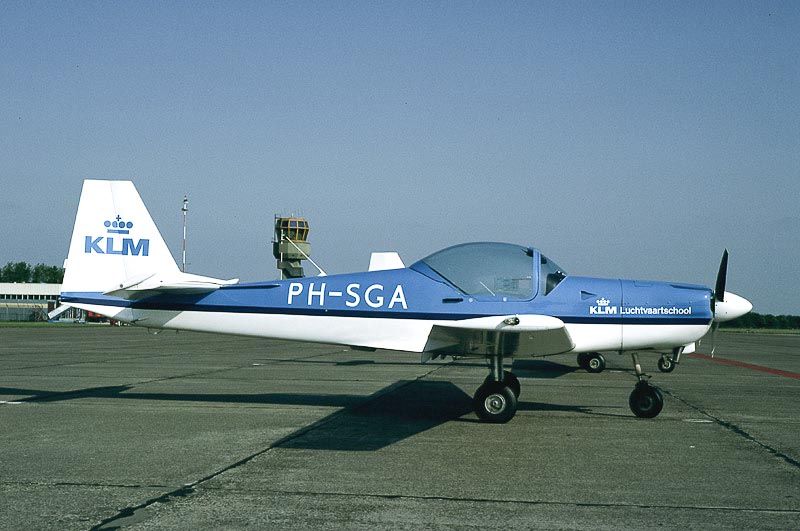
In 1990, the RLS bought 9 Slingsby T.67C-3 Firefly for the basic training. They replaced the eight Cessna F.152-IIs operating in
this role since 1980. The 1990-built Slingsby T67C-3 c/n 2074 was tested as G-7-137. On 16 Augustus 1990, the CofA for this airframe
was requested by Staat der Nederlanden/Rijksluchtvaartschool, Eelde, as PH-SBA. On 4 September 1990, the Slingsby T.67C-3 was
registered PH-SGA with Staat der Nederlanden/Ministerie van Verkeer en Waterstaat/Rijksluchtvaartdienst/Directie Rijksluchtvaartschool, Eelde.
When in August 1991, the KLM took over the RLS and transferred it into the KLM Luchtvaartschool: the aircraft were repainted in the basic KLM colours.
On 28 August 1991, the PH-SGA was registered with KLM Luchtvaartschool BV, Eelde. After the PH-SGA was withdrawn from use by the KLM Luchtvaartschool,
the airframe was sold in the UK. On 22 August 2002, registration PH-SGI was cancelled as exported to the UK. On 23 August 2002, the aircraft was
registered G-FLUG in the UK with G. Laden, North Ferriby.
On 6 May 1993, the KLM Luchtvaartschool' Slingsby T.67C-3 Firefly PH-SGA was seen at Goningen Airport Eelde (GRQ/EHHG).
The ICAO Aircraft Type Designator for the Slingsby T.67C-3 Firefly is RF6. |

 Luchtvaart déjà vu