|
The Aérospatiale SA 365 C3 Dauphin II is a twin-engined medium-weight transport helicopter; conventional configuration, with a
4-blade fully articulated main rotor and a ‘Fenestron’ type tail rotor, for up to 2 crew and 13 passengers. The SA 365 C3 model is
powered by two Turbomeca Arriel 1C2 Turbine engines. The twin-engine SA 365 was developed in 1973 by SNIAS
(Société Nationale Industrielle Aérospatiale) based on the single-engine SA 360 Dauphin, a commercially unsuccessful single-engine helicopter.
The SA 365 prototype F-WVKE, the SA 360 prototype fitted with 2 Turbomeca Arriel 1A Turboshafts, flew first on 24 January 1975. In 1977
production commenced with the initial production variant under the original designation SA 365 C, with deliveries starting in 1978.
French certification of this model was received in July 1978, with US FAA and British CAA certification following later that year.
Custon deliveries of the SA 365 C Dauphin II began in December 1978. The SA 365 C featured two 630 shp Arriel 1 turboshaft engines;
a Starflex main rotor hub and 3,400 kg as maximum take-off weight. Its Fenestron anti-torque device featured 13 metal blades.
On 26 March 1979, the SA 365 C1 powered by two Turbomeca Arriel 1A1 engines
recieved the Type Certificate by DGAC FR; on 18 February 1980 followed by the SA 365 C2, powered by two Turbomeca Arriel 1A2 engines;
and on 14 January 1982 followed by the SA 365 C3 powered by two Turbomeca Arriel 1C engines. An improved version of the SA 365 C
Dauphin II, the SA 365 N flew first on 31 March 1979. The SA 365 N differs from the SA 365 C in having Arriel 1C turbine engines, a
re-profiled fuselage, fully retractable undercarriage and increased fuel capacity in new under-floor tankage.
Deliveries of the production model began in 1982. Deliveries of the AS 365 N2, equipped with two Turboméca
Arriel 1C2 turboshafts, started in 1990. From 1984, SNIAS operated under the name of Aérospatiale.
The helicopter divisions of MBB from Germany and Aerospatiale from France merged in January 1992 to form the Eurocopter
Group. A new Eurocopter designation was added: EC155 B1, originally known as the AS 365 N4. The Dauphin II is in use
in several military and civilian roles. The AS 565 Panther is the military version of the Dauphin. The AS 366 G1,
powered by two Textron-Lycoming LTS.101-750B-2 turboshafts, is used by the United States Coast Guard under the
designation HH-65A Dolphin. The Dauphin II is manufactured under licence in China as the Harbin Z-9 Haitung and in
Brasil as the Helibras MH-1. Production ended in 2021 with more than 1100 AS365 N versions built: the last AS365 N3 was
delivered on 24 January 2022.
The ICAO Aircraft Type Designator for the Aérospatiale SA 365 C3 Dauphin II is S65C |
|
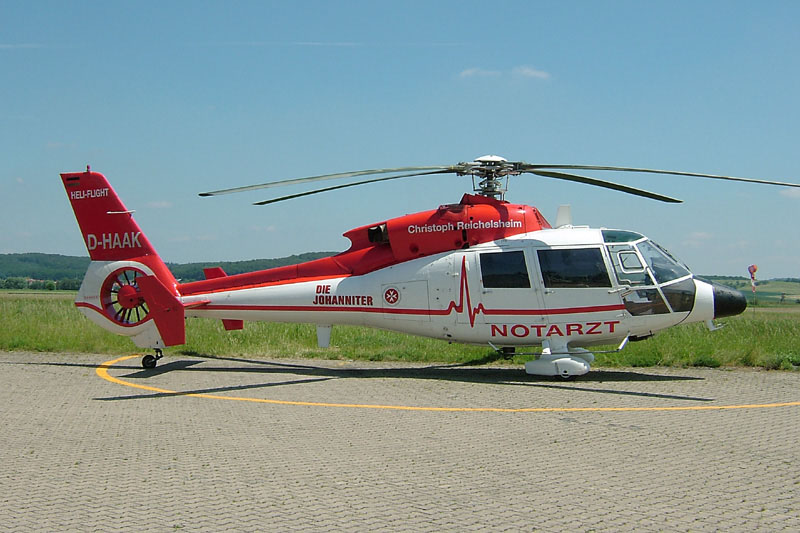
On 28 April 2006, the ITH "Christoph Reichelsheim" was
renamed "Christoph Hessen". The call sign "Christoph" is used for the
German lifeliner helicopters since 1970 and is derived of Saint
Christophorus, the Patron Saint for all travellers. The 1978-built
Aérospatiale SA 365 C3 Dauphin II D-HAAK is operated by Heli-Flight since February 1995. It was
originally delivered as a Aérospatiale SA 365 C1 and registered as YR-DFD in Romania. In
November 1988, the aircraft was registered D-HAAK in Germany as a Aérospatiale SA 365 C3 Dauphin II by Arcus-Air
Logistic GmbH, Köln/Bonn. In March 2007, the D-HAAK was replaced in service as "Christoph Hessen" by Eurocopter AS365 N
D-HFHE. In May 2007, Aérospatiale SA 365 C3 Dauphin II D-HAAK received new colours and is
operated as before by Heli-Flight out of Reichelsheim.
On 7 June 2004, Aérospatiale SA 365 C3 Dauphin II D-HAAK
was seen at Flugplatz Reichelheim (EDFB) in service with Heli-Flight as "Christoph Reichelsheim". |

 Luchtvaart déjà vu